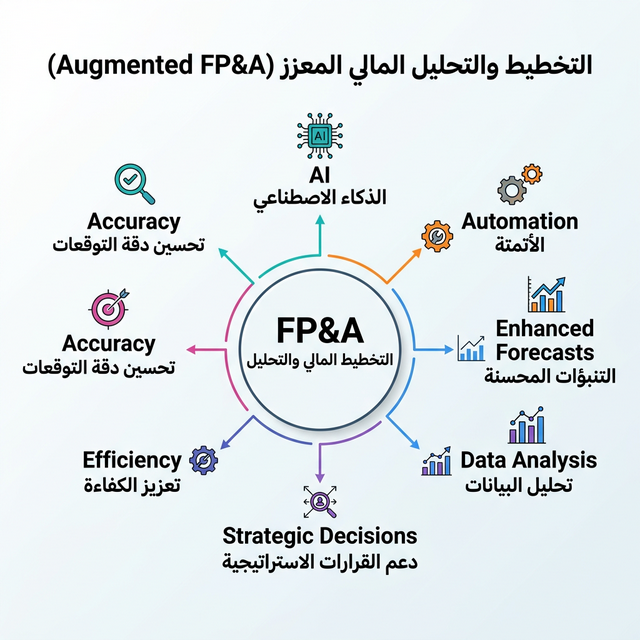
In today's fast-paced business world, Financial Managers face increasing challenges that require quick and accurate decision-making. This is where Financial Planning and Analysis (FP&A) comes in as a vital, indispensable tool. Before talking about the evolution towards Augmented FP&A, which integrates advanced technologies like AI and automation, it is essential to understand the traditional foundation of FP&A and its significance in building a strong financial strategy.
What is Financial Planning and Analysis (FP&A)?
Financial Planning and Analysis (FP&A) is a set of strategic processes designed to help organizations plan, forecast, and budget accurately to support major business decisions and future financial stability. FP&A encompasses the following elements:
Core Components of FP&A:
- Financial Planning: Establishing long-term and short-term financial strategies.
- Budgeting: Allocating financial resources based on specified goals.
- Financial Forecasting: Predicting future revenues, expenses, and cash flows.
- Scenario Modeling: Analyzing "what-if" scenarios to evaluate the impact of different decisions.
- Performance Reporting: Monitoring and analyzing actual financial performance against expectations.
The Difference Between FP&A and Traditional Accounting
It is crucial to understand that FP&A is not just accounting, although accounting plays a major role in the process. The main differences include:
Traditional Accounting:
- Focuses on past and current transactions.
- Records and documents financial events.
- Emphasizes accuracy and compliance with accounting standards.
Financial Planning and Analysis (FP&A):
- Looks to the future and focuses on strategic planning.
- Analyzes data for informed decision-making.
- Helps organizations adapt proactively to market shifts.
Importance of Traditional FP&A in Organizations
1. Measuring Financial Health
FP&A helps organizations assess their financial health through indicators such as cash coverage ratio, current and quick ratios, debt-to-equity ratio, alongside profitability and liquidity metrics.
2. Supporting Strategic Decision-Making
FP&A answers vital questions like: Should we raise debt or equity financing? What is the impact of an acquisition or divestiture on financial results? How much should be invested in property and equipment and when? And what is the company's break-even point?
3. Risk Management and Future Planning
Mitigating risk through "what-if" scenario analysis, predicting the impact of decisions on cash flow and profit margins, and creating dynamic operational and financial plans that allow for multiple scenarios.
Key Processes in the FP&A Cycle
- Data Gathering and Analysis: Using current and historical financial data, integrating operational and external data (market trends), and validating data accuracy.
- Forecasting and Budgeting: Estimating expenses needed to execute company plans, allocating a budget for each business unit or function, and consolidating budgets into a master budget.
- Performance Monitoring and Analysis: Analyzing sales, expenses, and profits, monitoring working capital and cash flows, and comparing actual results with estimates to conduct variance analysis.
Challenges Faced by Traditional FP&A
- Slow Processes: Relying on manual processes is time-consuming and makes it difficult to update forecasts quickly.
- Limited Scenario Analysis: According to the 2022 FP&A trends survey, only 6% of companies can run scenarios in real-time.
- Reliance on Static Models: Difficulty integrating data from multiple sources and coping with rapid changes.
Part Two: The Shift Toward Augmented Financial Planning and Analysis
After exploring the basics of traditional Financial Planning and Analysis in Part One, we now arrive at a critical tipping point. Augmented Financial Planning and Analysis (Augmented FP&A) is not just an incremental improvement, but a true revolution that redefines how finance teams operate.
What is Augmented FP&A?
It is a revolutionary evolution that integrates advanced technology with traditional financial processes to create an intelligent and efficient system, characterized by three main pillars:
1. Artificial Intelligence and Machine Learning
Revolutionizes FP&A by automating routine tasks, improving forecasting accuracy, and providing real-time insights. These systems can analyze complex datasets to identify patterns, trends, and enable instant anomaly detection.
2. Intelligent Automation
Reduces human errors, saves time (from days to hours), and allows analysts to focus on strategic analysis rather than administrative tasks.
3. Cloud Computing
Provides the technological foundation for instant data access from anywhere, improving cross-team collaboration and scalability.
Top Software and Tools for Augmented FP&A
- SAP Analytics Cloud: A comprehensive platform combining planning, analysis, and forecasting.
- Oracle Fusion Cloud ERP: An integrated system with built-in AI capabilities.
- Anaplan: Specialized in integrated planning and multi-dimensional analytics.
- Workday Adaptive Planning: To deliver real-time financial forecasting.
- Zeni AI: For automating accounting and spending for startups.
Part Three: Steps to Implement Augmented FP&A - A Practical Guide
Step One: Data Gathering and Consolidation
Data quality is the cornerstone. Internal sources (ERP, CRM) must be integrated with external sources (market data, economic indicators). AI plays a crucial role here by automatically cleaning data and standardizing formats.
Step Two: Multi-Scenario Planning
Once data is consolidated, models based on different assumptions can be created:
- Optimistic Scenario: High growth and low costs.
- Realistic Scenario: Moderate and sustainable growth.
- Pessimistic Scenario: Sales decline and increased costs.
Step Third: Dynamic Budgeting
By bypassing traditional static budgets, dynamic budgeting offers extraordinary flexibility. The budget is updated automatically based on actual performance (Rolling Forecasts), allowing for rapid responses to opportunities and challenges.
Are you ready to lead the financial transformation in your organization?
Request a service