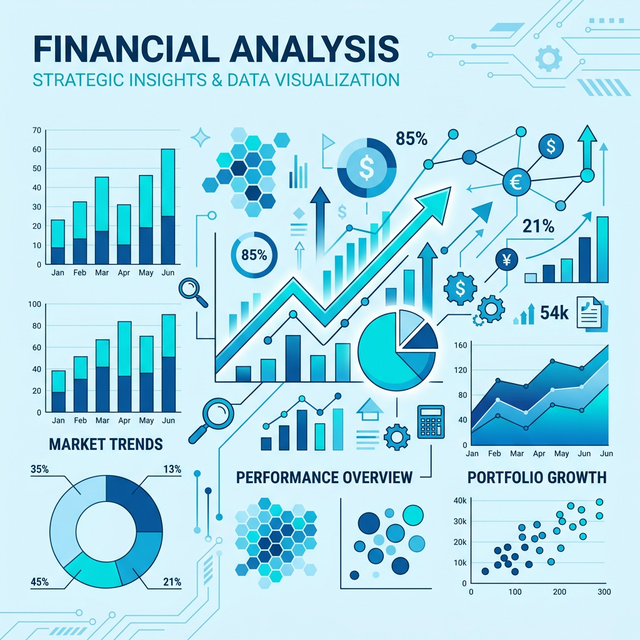
What is Financial Analysis and Why Does it Matter?
In the expansive world of business and investment, financial analysis (also known as accounting or fiscal analysis) is an indispensable evaluation tool. It refers to the meticulous process of assessing a company’s viability, economic stability, and long-term profitability.
Financial analysts generate comprehensive reports relying heavily on data extracted from balance sheets, income statements, and cash flows. This analysis equips top management with the empirical foundations required to make strategic choices, such as whether to lease or buy equipment, issue shares, negotiate bank loans for working capital, or continue operating specific business segments.
Primary Objectives of Financial Evaluation
By dissecting numerical data, analysts primarily focus on evaluating the following core pillars of corporate health:
- 1. Profitability Assessment: Gauging the entity’s capacity to generate income and sustain growth across both short and long horizons, typically tracked through income statements.
- 2. Solvency Analysis: Measuring the firm’s ability to honor long-term obligations to creditors. A reliable predictor of endurance during economic downturns.
- 3. Liquidity Evaluation: Ensuring the company maintains a resilient cash flow to meet short-term liabilities immediately, protecting daily operations.
- 4. Corporate Stability: The ultimate goal is ensuring the company can thrive long-term without hemorrhaging losses. It relies heavily on fusing data from both the balance sheet and income statements.
Key Types of Financial Analysis
1. Vertical Analysis (Common-Size Analysis)
This technique compares the company's financial statements over specific periods to track its historical progression, usually by reducing statement components to a relative percentage (e.g., dividing all income statement items by total sales). It helps management pinpoint shifting expense ratios and revenue trends over time.
2. Horizontal Analysis (Comparative Analysis)
Horizontal evaluation tracks the same financial metrics across multiple years to unearth growth trends. It is fundamentally used to juxtapose the company’s performance against industry competitors, giving a clear picture of market standing.
3. Ratio Analysis
The most common methodology, which utilizes specific financial ratios derived from the balance sheet and income statements to forge a sharp image of fiscal performance.
Crucial Financial Ratios Every Investor Should Know
Financial ratios distill complex accounting data into readable metrics:
- Liquidity Ratios: Measure short-term payoff capability. Example: Current Ratio = Current Assets ÷ Current Liabilities.
- Profitability Ratios: Indicate profit-generating power. Examples include Net Profit Margin and Return on Assets (ROA).
- Debt (Leverage) Ratios: Assess dependency on borrowed funds. Example: Debt-to-Equity = Total Debt ÷ Total Equity.
- Activity Ratios: Determine how efficiently the company utilizes its assets. Example: Inventory Turnover.
- Market Ratios: Used to measure stock performance against peers. Example: Price-to-Earnings Ratio (P/E).
Practical Examples from the Arab Markets
The Saudi Market (KSA)
For companies like Saudi Aramco, financial analysis is heavily utilized to compare its colossal numbers against global oil giants, calculating dividend distribution capacities and raw profitability metrics.
The UAE Market
For heavyweights like Emirates NBD, analysts execute rigorous ratio analysis to benchmark liquidity and solvency against competing regional banks, guaranteeing investor security.
The Egyptian Market
For industrial titans like Elsewedy Electric, horizontal analysis is employed to contrast its revenue growth and asset utilization within the wider energy and manufacturing sectors.
Creating Highly Accurate Financial Analysis in 6 Steps
- 1. Gather Reliable Data: Begin by collecting the core financial statements (income, balance sheet, cash flows).
- 2. Select Appropriate Tools: Use advanced spreadsheet models or automated accounting software (like Wafeq) to minimize human error.
- 3. Apply Standard Techniques: Utilize horizontal, vertical, and ratio methodologies combined.
- 4. Seek Patterns: Investigate spikes in expenses or unexpected revenue surges to locate underlying weaknesses or strengths.
- 5. Benchmark Against the Industry: The numbers mean little without context. Compare your data against industry averages.
- 6. Actionable Recommendations: Conclude with a clear, strategic report containing practical steps for the management team.
The Role of Modern Technology in Financial Analysis
Today, relying exclusively on manual calculation is obsolete. Advanced accounting systems streamline data extraction, allowing analysts to transition from simply crunching numbers to actively hunting for strategic insights.
- Automated Reporting: Instantly generating holistic financial reports with zero delay.
- Financial Forecasting: Deploying AI to predict cash-flow trends, enabling proactive corporate planning.
- System Integration: Linking accounting systems to operational databases for completely unified analytics.
Common Questions Regarding Financial Analysis
What is financial analysis and why is it important?
It is the process of examining a company's financial statements to assess stability and performance, enabling confident, data-backed investment and management decisions.
What is the main difference between horizontal and vertical analysis?
Vertical analysis compares financial data within a single period (reducing it to percentages of a base figure), whereas horizontal analysis tracks performance changes across multiple years.
Can non-financial data be utilized?
Yes, blending financial metrics with non-financial data (e.g., customer satisfaction, tech innovations, and sector trends) provides a richer, more accurate picture.