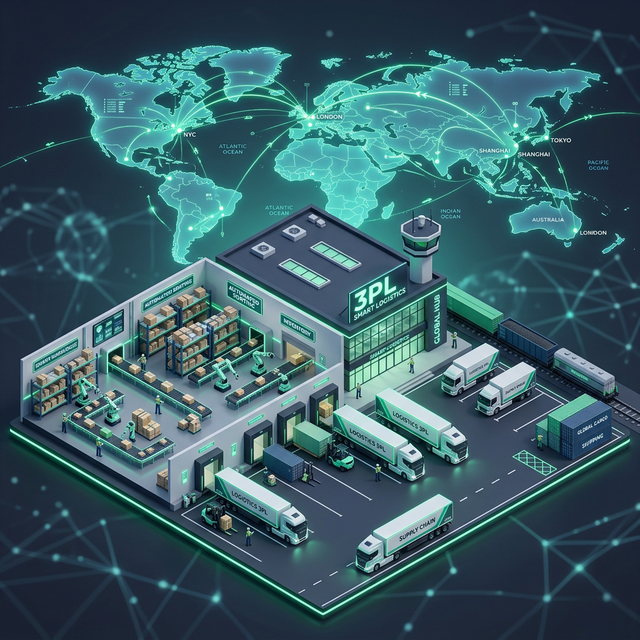
Third-Party Logistics (3PL) companies are specialized entities that handle integrated logistics tasks on behalf of commercial businesses. These companies aim to save time and effort and increase the operational efficiency of organizations.
What is the role of Third-Party Logistics companies?
Their role includes a wide range of vital services, such as:
- Warehouse Management: Providing secure and organized storage spaces.
- Inventory Management: Tracking merchandise levels and ensuring availability.
- Order Fulfillment: Preparing and packaging products accurately upon request.
- Shipping and Delivery: Managing the distribution network to ensure goods reach the end consumer.
- Returns Management: Processing returned products efficiently and quickly.
Instead of building their own massive infrastructures, companies can rely on these entities to expand their operations quickly and flexibly. These companies are responsible for storing and delivering products with high efficiency; for example, they often store, process, and ship goods within advanced logistics networks.
💡 Based on my experience, I can affirm that employing third-party logistics companies allows businesses to focus on their core activities without wasting time and resources on managing transportation and warehousing operations.
🚚 E-commerce Support and Customer Experience
These companies play a vital role in supporting e-commerce platforms and stores, especially in inner-city deliveries. Having logistics warehouses close to order centers brings tangible benefits:
- Speeds up Delivery: Meeting customer needs in record time.
- Improves Customer Experience: Providing reliable and professional service.
- Enhances Consumer Loyalty: Confidence in delivery speed and quality builds long-term relationships.
📊 Statistics show that top service providers achieve over 97% on-time delivery rates.
📦 Additionally, the **"last mile"** of delivery constitutes more than half of the total shipping cost. Therefore, optimizing this stage in collaboration with specialized companies is a fundamental element in the operational success of e-commerce.
📈 Key Performance Indicators (KPIs) and Their Importance
KPIs are quantitative measurement tools used to evaluate process effectiveness, supply chain efficiency, and customer satisfaction. These indicators direct efforts towards achieving strategic goals and are used to detect bottlenecks and improve performance.
📊 Key 3PL KPIs:
- ⏱️ On-Time Delivery Rate: Measures the percentage of orders delivered on the agreed time. High rate = customer trust and satisfaction.
- ✅ Order Accuracy: Measures the number of orders properly prepared and shipped. High accuracy = reduced errors and costs.
- 💰 Cost per Order: The average cost of executing a single order. A high rate indicates a need to identify sources of waste.
- 👷 Driver Retention Rate: The percentage of drivers who remain on the team. High rate = stable operations and lower employment costs.
- 😊 Customer Satisfaction Index: Measured through surveys, it reflects the quality of the customer experience.
- 🚗 Number of Orders per Driver Daily: An indicator of driver productivity and time management efficiency.
🛠️ Using KPIs for Decision Making
By periodically analyzing these indicators, financial and operational managers can:
- Detect weaknesses (like a drop in on-time delivery).
- Optimize costs by controlling processes and eliminating waste.
- Boost overall operational efficiency.
- Improve administrative policies and develop operational teams.
Conclusion: Relying on 3PL logistics companies and using performance indicators strategically enhances the customer experience, lowers costs, and gives businesses a true competitive edge in the logistics market.
Are you looking to improve your project's supply chain efficiency?
Contact Me Now for a Consultation